
[Image credit: It’s A Sensory World]
[TL;DR: 4 min read]
I recently saw a challenge to describe Scrum in 150 words or less to “a child upward of eleven years old”*.
So – here goes!:
“Scrum is a simple way for a team to work together to build a product step by step.
They have a big target called the Product Goal — this is what they want the final product to become. To reach it, they break the work into small, manageable Sprint Goals.Work happens in short blocks called Sprints (1 or 2 weeks ideally). For each Sprint, the team defines one Sprint Goal and builds a small, usable piece of the product that moves them closer to the Product Goal.
A Scrum Team has three roles:
- The Product Owner decides what is most valuable to work on.
- The Scrum Master helps the team do their best work and solve problems.
- The Developers create the product.
Scrum works because the team:
- Is open about progress,
- Inspects their work – and how they work – often,
- Adapts quickly based on what they learn to continuously improve.
REPEAT!”
I have not stress-tested this with a sample group of 11-year-olds (I imagine that would be stressful..), and maybe the feedback from them wouldn’t be great(!). But writing it this way highlighted something for me:
Scrum is only simple when it’s intentionally used as a goal-driven system.
The Official Scrum Guide reinforces this:
- “Scrum is a lightweight framework”
- “Scrum is simple”
- “The Scrum framework is purposefully incomplete”
- “Rather than provide people with detailed instructions, the rules guide relationships and interactions”
Instead of being prescriptive (like a methodology), the framework creates constraints to force better conversations, prioritisation, trade-offs and decisions.
–
Sprint Goal vs Sprint Backlog
Consider the difference between a Sprint Goal and a Sprint Backlog:
- The Sprint Goal is a commitment to the outcome the team agrees to work towards for the duration of the Sprint
- The Sprint Backlog is not a commitment. It is a plan. And this plan can be changed. During the Sprint, every 24 hours, the team is purposefully encouraged to inspect whether this plan needs to be adapted to achieve the Sprint Goal at the Daily Scrum
–
Alignment: the power of one goal
Another take-away for me was alignment:
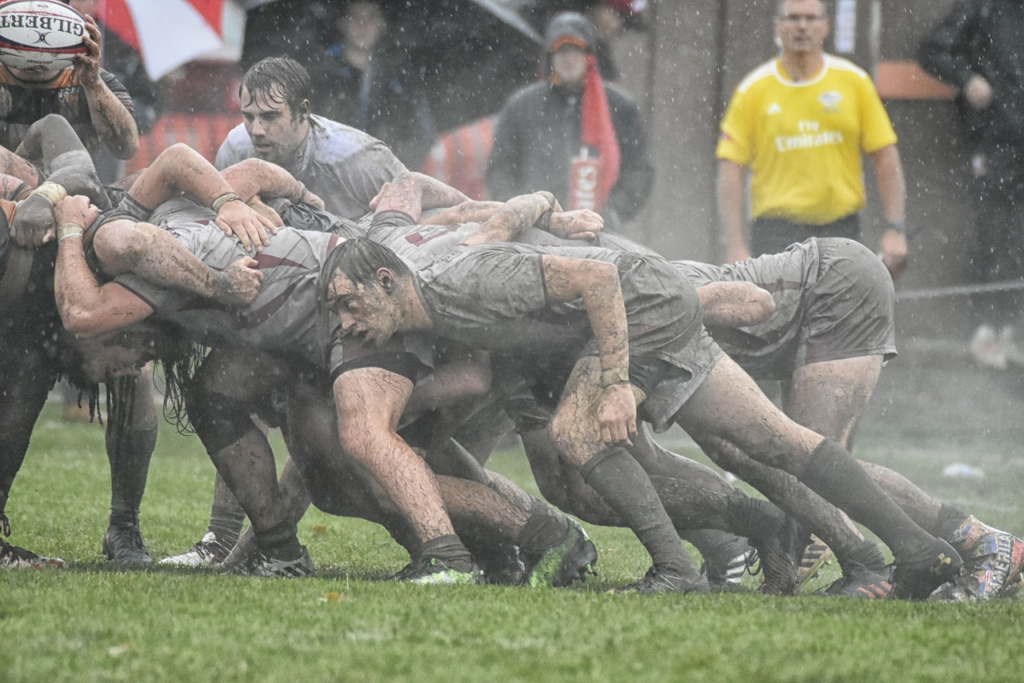
[Image credit: needpix.com]
“‘Scrum’ comes from the game of rugby, it refers to the way a team works together to move the ball down the field – alignment, unity of purpose, and clarity of goal. The perfect metaphor for what I want teams to do.”
– Dr Jeff Sutherland (Scrum co-creator)**
In rugby, a scrum only works if everyone pushes in the same direction.
If players push in different directions, it weakens and is at risk of collapse.
The same is true in Scrum:
The team works together.
One goal at a time.
These constraints drives collaboration, reduces fragmentation, and helps avoid drifting into harmful anti-patterns ✋ 🛑:
- ❌ A stream of tasks.
- ❌ A feature factory focused on output.
- ❌ Ceremonies without direction.
Instead, it unites the team behind the delivery of a single shared, valuable outcome 👍 🟢 ✅.
–
The Simplicity of Scalable Goals

[Image credit: Ann H, Pexels]
Now this is where Scrum can really amplify value across the entire system!
Imagine a world where:
- each Product Goal contributes to a strategic organisational goal (for example, an OKR)
- each strategic goal contributes to your organisation’s North Star
- and your North Star clearly aligns with the Mission, Vision, Purpose and Values
A connected system of goals.
Transparent.
Measurable.
Aligned.
Could this be explained to an 11-year-old?
Or at least to leadership, business stakeholders, and the wider organisation?
If you are doing this, I congratulate you.
If you are not — why not?
–
My Inspection & Adaptation
So while this may not land with an 11-year-old, it’s been a useful reset for me.
Maybe for you too.
Scrum isn’t complicated.
We just make it that way when we stop focusing on the goal.
Kevin North
(RSM, RPO, RS@SP, RSM@S, RVSM, RALS@S, RGAP, RFB, PSK, PAL-EBM, ICP-ACC, ICP-ENT, ICP-CAT, Agile MBA)
References:
*Scrum in Plain Language, Tobias Mayer
**The Red Book,Dr Jeff Sutherland
WHAT ARE YOUR THOUGHTS ON THIS ARTICLE?
*SHARE YOUR FEEDBACK OR QUESTIONS IN THE COMMENTS 👉HERE👈*.
For valuable insights on Business Agility, Patterns & AI check out the Adaptive Outcomes Collective (A.O.C.) today!