[TL;DR: 6 min read]
In my last article I tried to explain Scrum within 150 words to an 11-year-old. The reset proved useful: it reminded me that Scrum can be explained clearly, but also that it is only one part of the ‘Agile’ picture.
Most commercial Agile qualifications are built around exactly that one part. One framework, one role, and usually two days in a room (physical or virtual). You learn to be a Scrum Master or a Product Owner or a SAFe practitioner, pass the exam and add the letters to your name (I have a few of those myself).
There’s nothing wrong with that. However, it’s only one part of the bigger picture, and a lot of teams get stuck somewhere else in it.
Full disclosure before I go any further. I am a Board Member at The Job Hackers, a non-profit, and act as their Operating Model, AI & OKR Consultant. I sometimes host their Monthly Meetup , but I don’t teach on the Agile MBA™. I took the entire course as a student in Q3 2025, so what follows is from the student’s side of the screen. The views expressed here are my own.
–
What you actually get
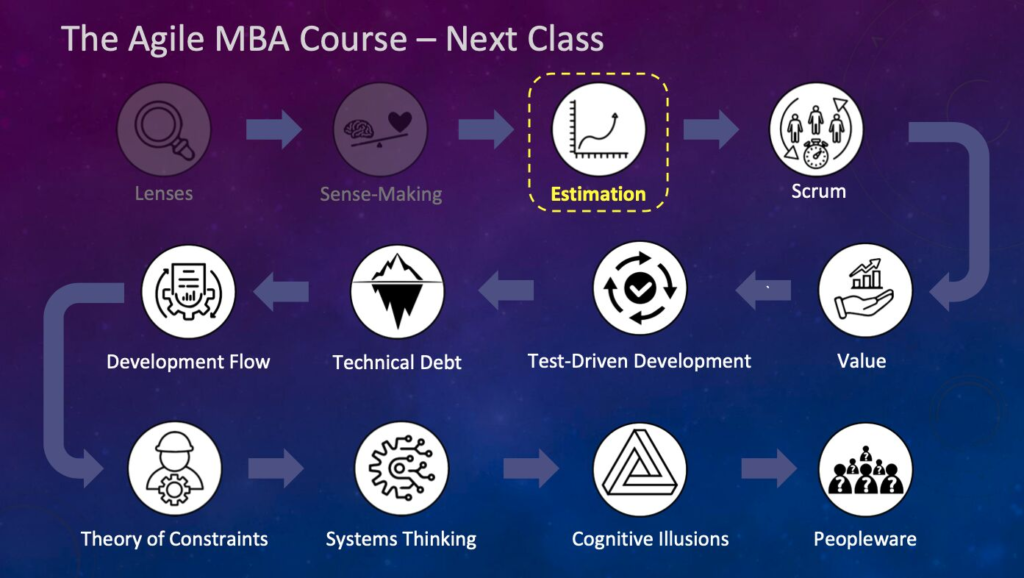
The Agile MBA™ is a Quarterly event that runs for six weeks, featuring 12 live sessions on Zoom on Tuesdays and Thursdays. This schedule accumulates 18 hours of live teaching and provides regular opportunities for real-time questions and feedback.
*💡 Enrollment for the Q4 Cohort closes on Monday 12th October, 2026 ⏰*
Additionally, there are optional Friday discussion sessions for case studies and certification prep, recordings of every class, and a Slack community that stays with you after the final session.
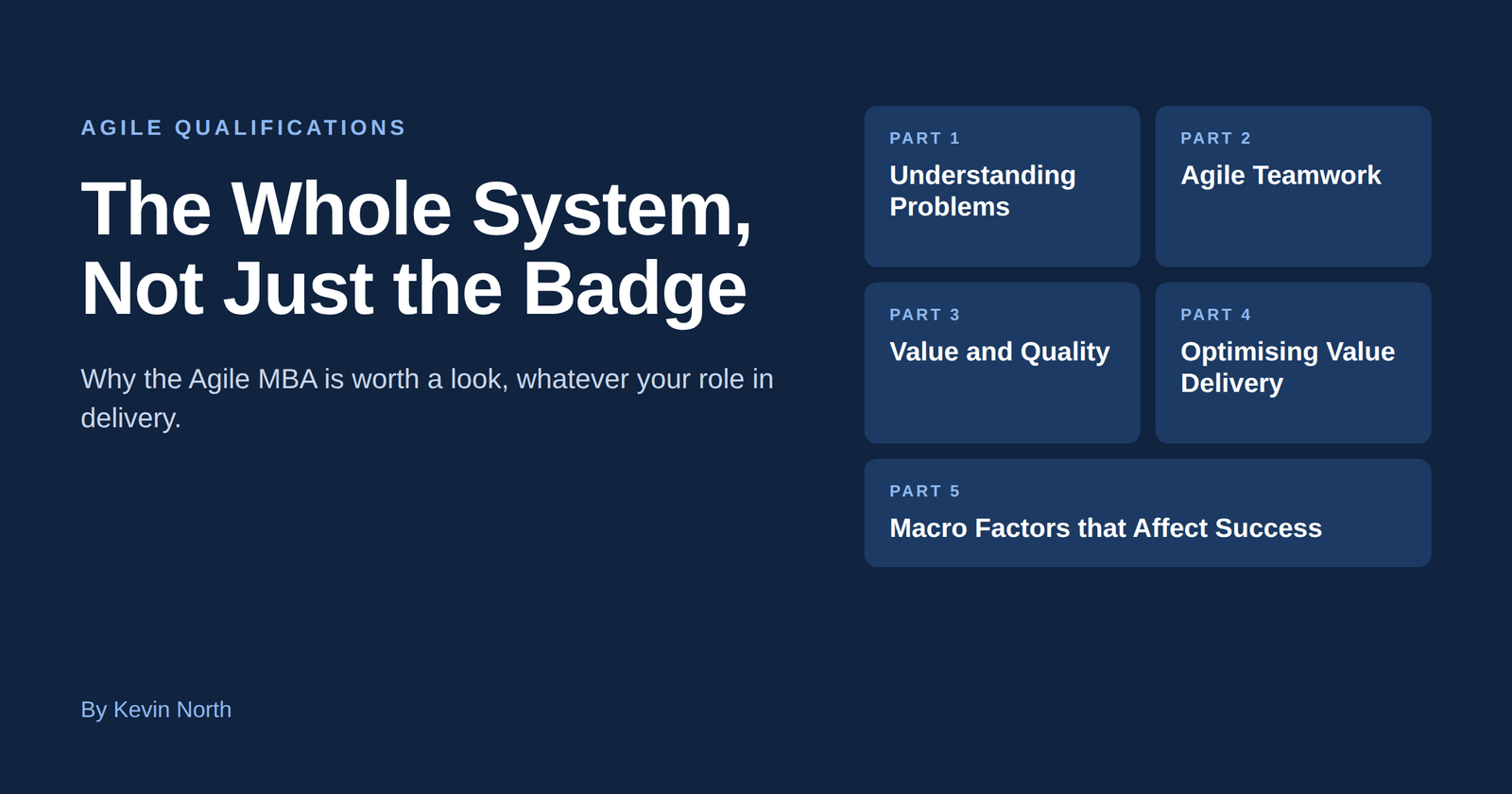
The curriculum is built in roughly five parts:
- Understanding Problems: perception and sense-making (Cynefin), the Agile Manifesto and relative estimation
- Agile Teamwork: Scrum, first the what and why, then the how
- Value and Quality: outcomes over outputs, backlogs, TDD, BDD and technical debt
- Optimizing Value Delivery: Reinertsen’s principles of product development flow (queues, batch size, WIP) and the Theory of Constraints
- Macro Factors that Affect Success: systems thinking, cognitive illusions and biases, and Peopleware, which now includes a look at ‘AI-ware’ and leadership
Each class is led by a practitioner. They include experts in Business Agility, Product, UX and Scrum.
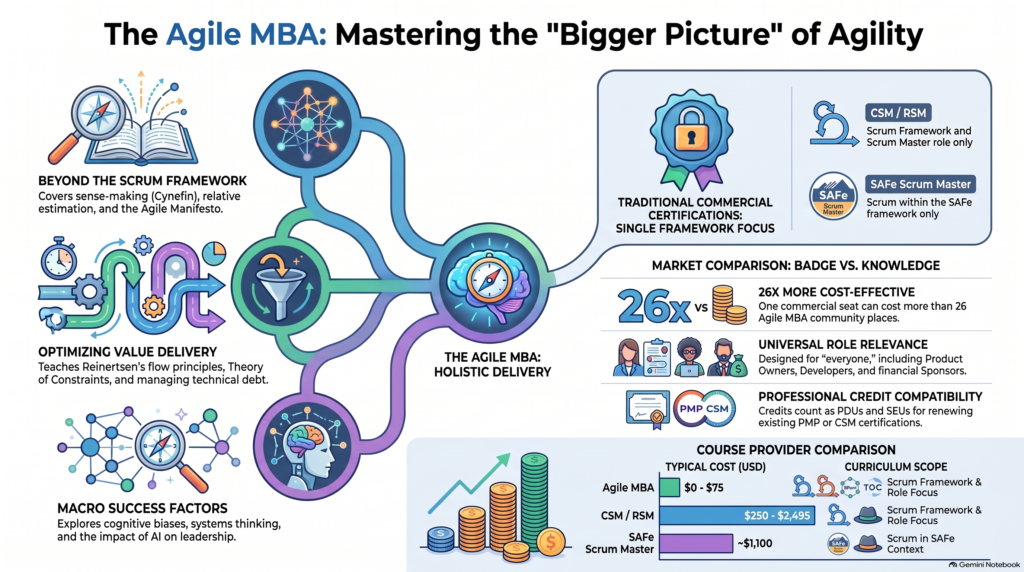
For me that breadth was the point. The course gave me a holistic view that isn’t limited to one framework, one job role (Scrum Master only, Coach only, Product Owner only) or one approach. So flow gets taught alongside Scrum, and cognitive bias alongside backlogs. That’s much closer to how the work actually shows up on a Monday morning.
–
Not Just For Scrum Masters

[Image credit: Unsplash/ Vitaly Gariev]
The course orientation deck asks “Who is the Agile MBA for?” and answers in one word: “EVERRRRYONE!!!” (their Rs, not mine). The curriculum backs that up, because each group that has a stake in delivery gets sessions written for them.
Product Managers and Product Owners get the Value sessions: output versus outcome, why code doesn’t automatically equal value, and how to test whether something is worth building before you build it. In some cases you can do that without writing any code at all, using prototypes, ad tests or AI coding tools.
Developers get test-driven and behavior-driven development, technical debt, and Scrum seen from the team’s side of the board rather than only the facilitator’s.
Sponsors, leaders and anyone investing in delivery get the economics. That covers Reinertsen’s case for taking an economic view of product development (lower cost, faster time to market, more revenue), the Theory of Constraints and systems thinking. There’s also a Peopleware session that asks directly how expectations of leaders and managers differ in an Agile environment, from incentives and performance management to who makes decisions and how.
In constrast, the commercial routes mostly split these audiences up. Scrum Alliance includes CSM and CSPO, Scrum Inc RSM and RPO, Scrum. org PSM and PSPO, and SAFe runs a separate course for almost every role. So a Scrum Master, a Product Owner and the person funding their work could need three different courses just to start from the same shared understanding. On the Agile MBA™ they can sit in the same class.
–
Side by Side
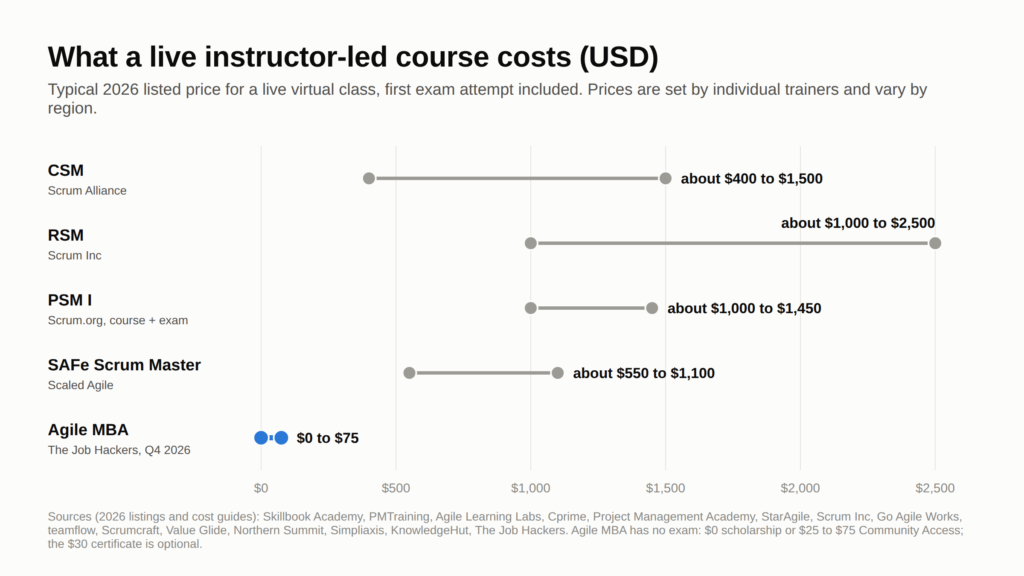
Here’s how the Scrum Master routes people most often ask me about might compare:
| Course | Typical instructor-led live virtual course price (USD), first exam included | Live training | Scope | Renewal |
|---|---|---|---|---|
| CSM (Scrum Alliance) | about $400 to $1,500 | 16 hours over 2 to 3 days | Scrum, Scrum Master role | Every 2 years, with SEUs and a fee |
| RSM (Scrum Inc) | about $1,000 to $2,500 | 14 hours or more over 2 days | Scrum, Scrum Master role | Yearly, with a short re-exam and fee |
| PSM I (Scrum.org) | about $1,000 to $1,450 | 2 days | Scrum, Scrum Master role | None |
| SAFe Scrum Master (Scaled Agile) | about $550 to $1,100 | 16 hours over 2 to 3 days | Scrum within SAFe | Yearly, about $195 |
| Agile MBA (Q4 2026) | $0 to $75 for most participants (no exam; optional certificate $30) | 18 hours over 6 weeks, plus Fridays | Agile, Scrum, value, flow, TOC, systems thinking, cognitive bias, Peopleware | None |
All four commercial rows use the same measure: an instructor-led, live virtual course (not self-paced) with the first exam attempt included where applicable, because that’s how most people actually earn these credentials. Prices are set by individual trainers and vary by region, so treat them as typical 2026 listings rather than fixed prices. Even the cheapest live CSM class I found ($399) would fund five Agile MBA™ places at the top Community Access rate, and a typical RSM or PSM course at around $1,000 would fund 13 or more Agile MBA™ places at the top Community Access rate.
*💡 Enrollment for the Q4 Cohort closes on Monday 12th October, 2026 ⏰*
–
The Honest Objection
The Agile MBA™ gives you a Certificate of Attendance, not a certification. And the certificate is entirely optional. Nobody has to pay the $30, and you get the full course, the recordings and the community without it. If you do want one, you earn it by attending the required number of the 12 live sessions.
So if a job advert filters on ‘CSM, RSM or PSM’, this course on its own won’t get you through that filter.
However, the course is designed to prepare you for PSM I. It also carries up to 27 PDUs (PMI) and 27 SEUs (Scrum Alliance), which count towards PMP, PMI-ACP and CSM renewals. So effectively it works alongside the badge rather than instead of it. If you take the course and then sit the $200 PSM I exam, you’ve still spent less than most two-day workshops cost, and you’ll have six weeks of context behind the letters.
–
Why is it so cheap?
The Job Hackers is volunteer-run, and 100% of contributions go towards the mission (mainly admin costs and tools). For Q4 there are three routes in:
- Full Access Scholarship: $0, 50 places, by application
- Community Access: a $25 to $75 sliding scale, 50 places
- Mission Supporter: $900, which includes a guaranteed PSM I exam retake
*💡 Enrollment for the Q4 Cohort closes on Monday 12th October, 2026 ⏰*
The optional certificate sits outside all three, so a scholarship place really can cost you nothing. There are no prerequisites and no technical background is needed. The course is rated 4.98 out of 5 on SwitchUp from more than 140 reviews.
–
Key dates for the Q4 2026 cohort
Enrolment opened: 18 September
Enrolment closes: 12 October, 10:00pm PT
Class 1: 13 October
–
My Inspection & Adaptation
[Image credit: Pexels / Clip It Comunicación]
I still value the other qualifications I paid for. But not all of them taught me why queues quietly wreck a delivery date, or how a team’s incentives shape its behaviour more than its framework does. The Agile MBA™ did, for a fraction of the price.
So whether you’re a Scrum Master, a Product Manager, a Developer or the person signing off the budget, ask yourself what you want to come out with. Only letters after your name, or additionally an understanding of the bigger picture?
And if the understanding costs you $75 or less, what’s stopping you?: https://www.thejobhackers.org/enrollment-agilemba/
*💡 Enrollment for the Q4 Cohort closes on Monday 12th October, 2026 ⏰*
Kevin North
(RSM, RPO, RS@SP, RSM@S, RVSM, RALS@S, RGAP, RFB, PSK, PAL-EBM, ICP-ACC, ICP-ENT, ICP-CAT, Agile MBA)
References:
- The Job Hackers: Agile MBA Participant page
- The Job Hackers: Agile MBA Q4 2026 Enrollment
- Scrum Alliance: Certified ScrumMaster
- Scrum Inc: Agile & Scrum Training
- Scrum.org: Professional Scrum Master I
- KnowledgeHut: Scrum Master Certification Cost in 2026
- Cloudwards: Best Scrum Certification for 2026
- RSM Practice Test: RSM Requirements 2026
- StarAgile: PSM Certification Cost 2026
- SysArt Consulting: Comparing Scrum Master Certifications
- Go Agile Works: Registered Scrum Master Training
- Simpliaxis: SAFe Scrum Master Certification Cost 2026
- teamflow: Registered Scrum Master
- Scrumcraft: Registered Scrum Master course
- Value Glide: Registered Scrum Master course
- Skillbook Academy: CSM live online class
- PMTraining: CSM live class schedule
- Agile Learning Labs: Certified ScrumMaster workshop
- Cprime: Certified ScrumMaster Workshop
- Project Management Academy: CSM Training
WHAT ARE YOUR THOUGHTS ON THIS ARTICLE?
*SHARE YOUR FEEDBACK OR QUESTIONS IN THE COMMENTS 👉HERE👈*.
For valuable insights on Business Agility, Patterns & AI check out the Adaptive Outcomes Collective (A.O.C.) today!