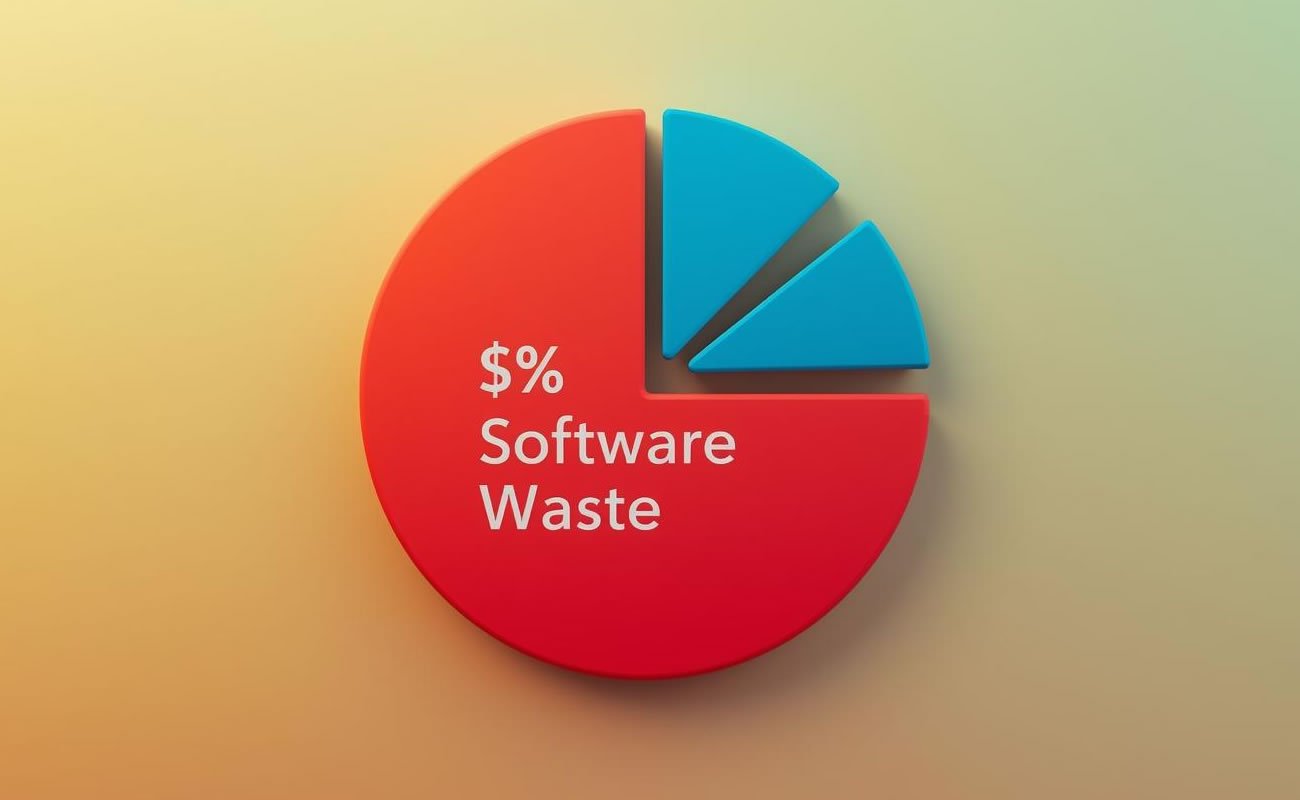
The 64% Problem: An Analysis of Unused Software Features
The Standish Group released a stunning finding that every technology leader must internalize: an average of 64% of all developed software features are rarely or never used by customers. This enormous, systemic waste highlights the true cost of unused software features – not just in terms of sunk development time, but in lost organizational focus, increased complexity, and delayed business value. This pervasive issue, often referred to as the “64% Problem,” is a direct result of delayed feedback and flawed planning models.
Why Does This Happen? The Root Cause
The 64% Problem is fundamentally a communication and time-to-feedback issue. In traditional, sequential development environments, requirements are gathered, finalized, and signed off on long before the customer sees a working product. This creates a dangerous knowledge gap:
- The Time Gap: When a request takes 6, 9, or 12 months to reach the customer, their needs, market conditions, and competition have inevitably changed. The delivered feature addresses yesterday’s problem, not today’s.
- The Interpretation Gap: Requirements written on paper or in a document are subject to misinterpretation as they pass from business stakeholder to analyst, to developer, to tester. Each hand-off introduces noise and drift, resulting in a feature that is technically correct but functionally useless.
The longer the feedback loop, the higher the risk that the feature will fall into the useless 64%.
The 64% Breakdown: Where the Budget Dies
In a simple $1 million budget scenario, the organization is effectively throwing $640,000 into the trash by building features based on old requirements.
The findings are stark for plan-driven, long-cycle projects:
- 45% of features are never used at all (entirely redundant).
- 19% of features are rarely used (do not justify investment).
- Only 17% of features are always used (drive true value).
The True Cost: More Than Just Development Time
The cost of unused software features extends far beyond the salaries paid to build them. This technical debris has ongoing negative impacts on the product and the organization:
- Increased Maintenance and Bugs: Every line of code, whether used or not, must be maintained, documented, and tested. Unused features create a larger surface area for bugs and demand valuable engineering time for patches and dependency updates.
- Complexity and Technical Debt: Dead or unused code makes the application larger and more complex. New developers struggle to navigate the bloated codebase, slowing down future development and increasing the time required for onboarding and feature changes.
- Slower Performance: Bloated code, unnecessary database calls, and unused libraries can contribute to larger application builds and slower load times, degrading the experience for the features that are used.
The Agile Solution: Mitigating the 64% Risk
The only way to effectively combat the 64% Problem is to drastically reduce the time between idea and validated feedback. This is the core principle of Agile development:
- Short Feedback Loops: By delivering working software every two to four weeks, the organization forces a rapid validation cycle. A feature that adds no value is identified quickly, and development pivots before significant investment is made.
- Minimum Viable Features (MVFs): Instead of building the “full vision” of a feature suite, Agile encourages delivering the smallest possible slice of value (the MVF). This minimizes the initial investment and forces the feature to prove its worth in the real world before further funding is committed.
- Build-Measure-Learn: Teams continuously release, gather quantitative and qualitative data on usage, and decide whether to persevere, pivot, or prune the feature based on actual user engagement, not initial assumptions.